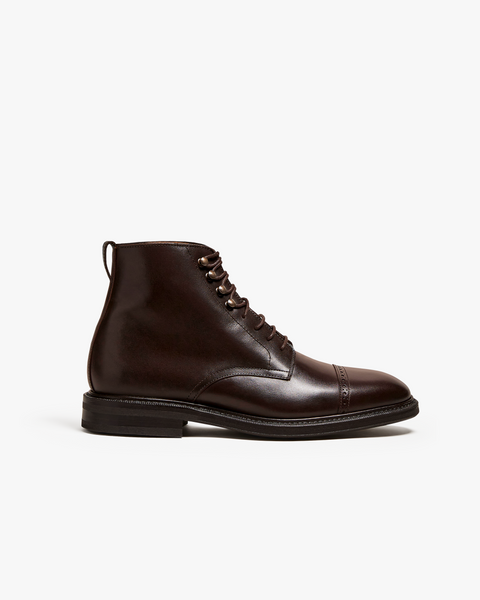
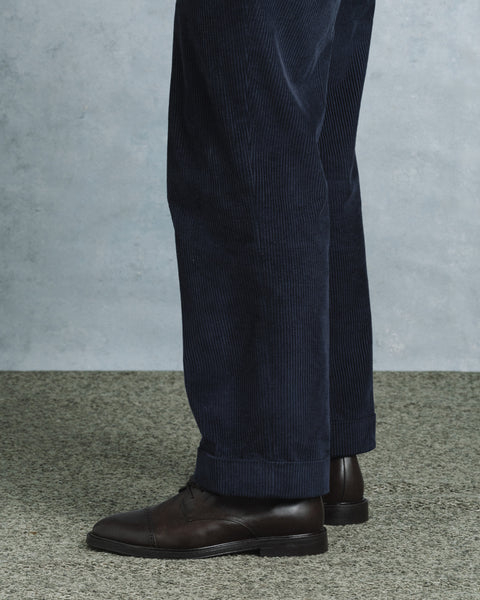
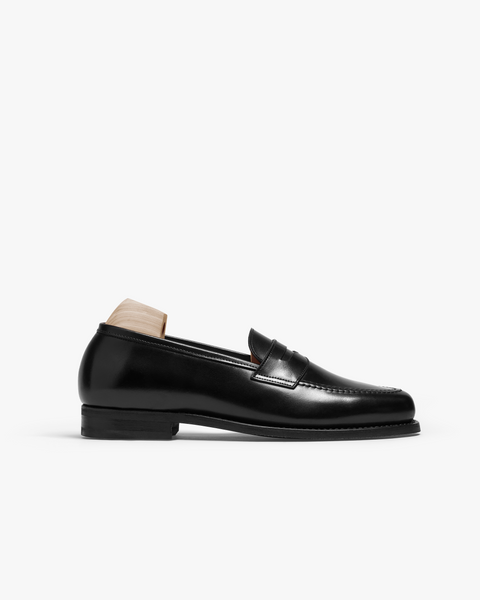
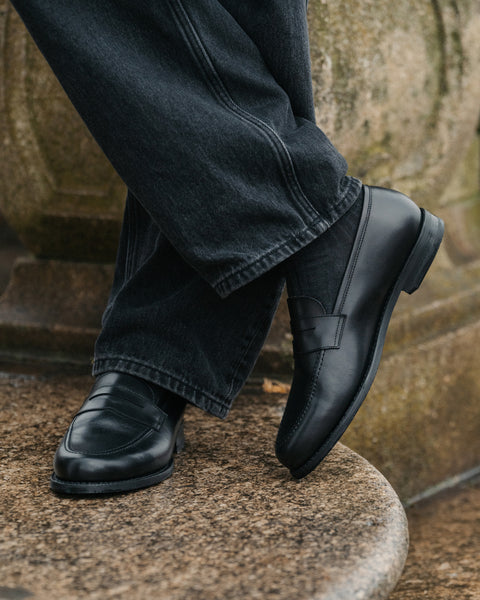
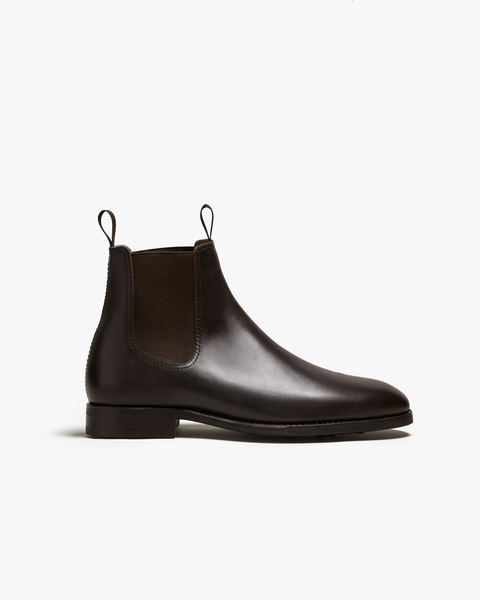
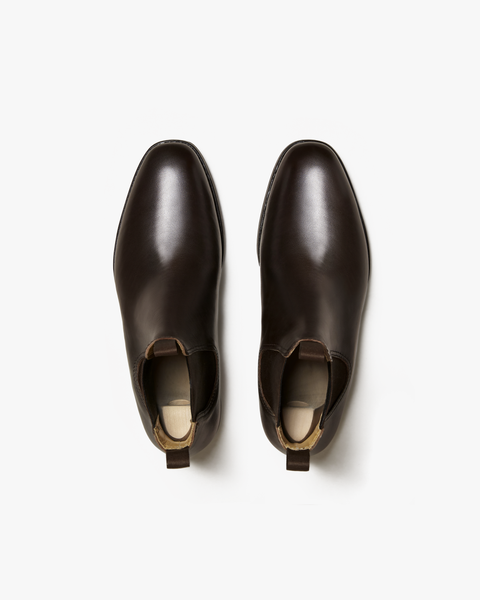
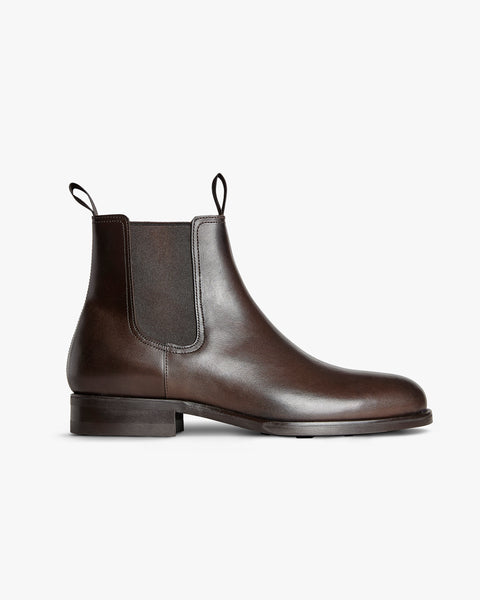
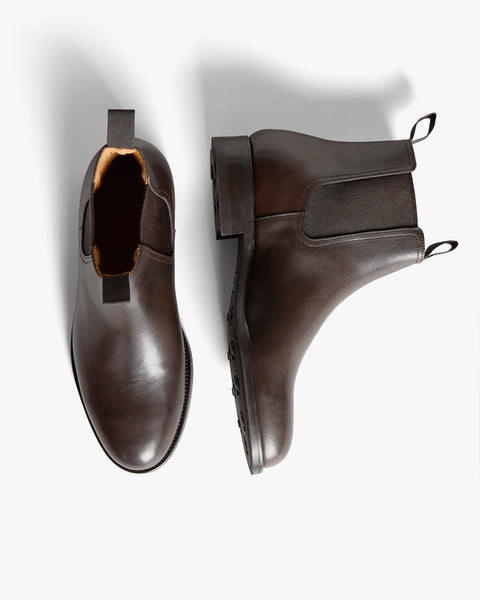

From a few feet away, an oxford and a derby are the same shoe. The whole difference is one seam: on an oxford the eyelet facings are stitched under the vamp and sewn shut at the bottom; on a derby they sit open on top. Everything else, cap toe to sole, can match exactly. Closed lacing looks sleeker, which is why the oxford is the more formal of the two, and the monk strap (a buckle instead of laces) sits in between — dressy enough for most suits, a step below the black cap-toe oxford, which is still the most formal shoe you can own.
Shops and style guides treat these as three separate shoes to learn, which makes the choice sound harder than it is. Set side by side they're nearly the same shoe: dark leather, a thin sole, often the same cap toe. The real difference is how each one closes over your foot, and once you can see it, the rest follows — how formal the shoe reads, whose feet it fits, which pair to buy first.
Closed lacing, open lacing
The facings are the flaps the laces thread through, and they're where the two shoes differ. On an oxford the facings are stitched under the vamp (the front panel of the shoe), so the bottom of the lacing is sewn shut and the two sides pull together into a neat V. On a derby they sit on top of the vamp, open at the bottom and free to spread. That's the entire structural difference. Above that seam the two shoes can be twins: same cap toe, same brogueing, same sole.
To tell them apart, find the lowest point of the lacing: if it's sewn shut, it's an oxford; if the flaps lift clear of the shoe, it's a derby. The closed throat makes a cleaner line up the foot, and that neatness is the whole reason an oxford reads dressier. The open facings do something an oxford's can't: they spread and close around the foot as you lace it. That turns out to matter for fit, and we'll come back to it.
Where each one sits
The order of formality follows from the lacing. Loafers sit at the casual end, then derbies, then monk straps, with the oxford at the top. The black cap-toe oxford is the benchmark the rest are measured against — the business shoe, correct under a suit and correct with black tie. A derby is a clear step down, though it still works under tailoring if you keep it plain. Monks are the only real argument: most people place them between derby and oxford, and a minority writes them off as 'loafers for people who hate loafers'.
Colour matters almost as much as construction. Black is the formal choice; dark brown is the one you'll actually wear most days. And honestly, few people notice the lacing across a room any more — a shoe gets judged on its toe, its leather, its sole and its shine long before anyone reads the throat. Our types of dress shoes guide covers the rest of the family and where each style falls.
Where you wear them tracks the same order. The oxford covers the strict end: conservative offices, weddings, and black tie in a plain cap-toe or wholecut. A derby covers the broad middle — chinos, odd trousers, dark denim, a suede pair in summer. A monk works with a suit or with chinos, and most wearers stop short of jeans.
The overlap is bigger than the ranking suggests. Keep a derby plain, with no heavy brogueing and no busy stitching, and it comes close to an oxford and sits fine under a suit. Our oxfords are the shoes for the strictest dress codes; the derbys handle everything looser.
Wide feet
The open lacing does more than change how the shoe looks — it changes how it fits. Because a derby's facings aren't stitched down, they spread over the instep as you tighten the laces, so the shoe adjusts to the foot inside it. An oxford closes over a fixed span, and on a broad foot or a high instep the two sides can strain until the leather bulges around the knot. That's why a derby is the safer buy for wider feet, and the easier shoe to wear with an orthotic or a thick winter sock.
Fit is a good enough reason to pick a derby even on a day when an oxford would be the dressier call. With ours it comes down to the last: the Orust II and the Boden II are built on Last #8, our F-width last, with extra room through the forefoot and instep. Not every derby runs wide, though, so measure on a Brannock, learn your width, and buy true to size.
Monk straps
Swap the laces for a buckle and you have the third closure. A monk strap sits between derby and oxford: worn under a suit more readily than a derby, and fine in all but the most conservative offices. The single monk, with one buckle, is the quieter and slightly dressier of the two; in smooth dark calf it comes close to an oxford. The double monk, with two buckles, is the statement version. Where a given pair lands depends on the detailing — smooth leather and small, low-shine buckles push it up the scale; wide straps, an apron toe and rougher leathers pull it down.
Colour matters here more than anywhere else. A black double monk is awkward to place: it suits a wedding or a cocktail hour better than the office or a weekend. Brown is far easier and will even take chinos. Our monk strap is a double, made in black or dark-brown calf and dark-brown suede.
If you've read that monk straps are dated, or a shoe for older men, the worry traces back to one period. Double monks were the signature shoe of the menswear-blog boom, roughly 2008 to 2015, and they were worn so hard in those years that for a while they read as trying too hard. That was a styling moment, not a problem with the shoe. Style one by its formality instead: quiet buckles, restrained leather, a suit or smart chinos rather than everyday knockabout wear. Worn like that, it looks entirely at ease.
Blucher, balmoral, wingtip
A few more names come up around these shoes, and most of them describe a detail rather than a different shoe. In everyday use a blucher is a derby: both are open-laced. The textbook difference is in the vamp (a true blucher is cut in one piece with the lacing tabs stitched on, a derby in separate quarters), but nobody polices it and the words get swapped freely. That interchangeability also answers a question people keep asking: yes, a derby is essentially an open-laced oxford. Balmoral is the same story on the other side, a closed-lacing oxford under a grander name, and American shops in particular will say 'bal' and 'blucher' where a British shop says oxford and derby.
The rest are toe and pattern words. A cap toe has a seam across the toe; a wholecut is cut from a single piece of leather with almost no seams at all. A wingtip carries a W-shaped toe cap, and brogueing is the punched decoration, graded from quarter through semi to full. One rule ties them together: the more decoration a shoe carries, the more casual it reads. That's why the most formal shoe you can own is a plain black cap-toe oxford, not a brogued one.
Getting the bars straight
Most dress shoes arrive laced criss-cross, which is the casual default and impossible to get wrong. The dressier finish is straight-bar lacing, also called parallel or bar lacing: the laces run as flat horizontal bars with no crossing on show, which matches the clean line of a closed throat. The catch is an odd number of eyelet pairs, three or five on some shoes, where an evenly started lace leaves one end pointing down into the shoe instead of out at the top. The fix is to start uneven.
Start with an uneven offset
Feed the lace straight across the bottom pair of eyelets, going in from the top so the ends come out underneath. Pull one end about two inches longer than the other — this offset is what lets both ends finish cleanly at the top later.
Send the short end up one side
Take the shorter end straight up to the next eyelet on the same side, then cross it underneath to emerge through the eyelet opposite, ready to lay the next horizontal bar.
Build the horizontal bars
Work that end up the shoe one eyelet at a time, each time crossing underneath and coming out to lay a flat bar across the front. Keep the tension even so the facings stay parallel.
Bring the long end to meet it
Lace the longer end up the hidden path underneath in the same way, climbing behind the shoe to the last eyelet on its side. Because you started it longer, it reaches the top rather than disappearing inside.
Finish at the top eyelets
Both ends now exit the top pair of eyelets, ready to tie. On an oxford the facings should sit close together with only a slim gap; on a derby they can splay a little more. Either way: snug, not straining.

Worth resoling
Before you buy any of the three, turn the shoe over. A Goodyear-welted or Blake-stitched sole can be taken apart and replaced by any decent cobbler. A cemented sole, glued straight on, generally can't be, so when it wears through you replace the shoe, not the sole. Looked after, a welted pair lasts a decade or more. If you want the mechanics, our guide to what a Goodyear welt actually is covers the stitching and how it differs from Blake.
Ours are made by hand in Portugal and mostly Goodyear-welted, the Äppelviken II oxford and the Orust II derby among them. A few of the sleeker shoes are Blake-stitched instead, which trades a little weatherproofing for a slimmer sole.
The first pair
If you're buying one pair, make it a black cap-toe oxford. Nothing else covers as much ground: an interview, a wedding, a funeral, and (in a plain-toe or wholecut version) black tie. The second pair adds range — a dark-brown derby or oxford goes with navy, grey and olive, and covers the smart-casual days a black shoe can't. Our Äppelviken II is that dark-brown cap-toe oxford, Goodyear-welted so a cobbler can keep it going for years.
Before you pay, check three things: that the shoe is welted or Blake-stitched so it can be resoled, that it fits true to size, and that the toe is plain enough for the dressiest thing you'll wear it to. And if your feet run wide, take the earlier hint and start with a derby.
One of each, in leather
View all


