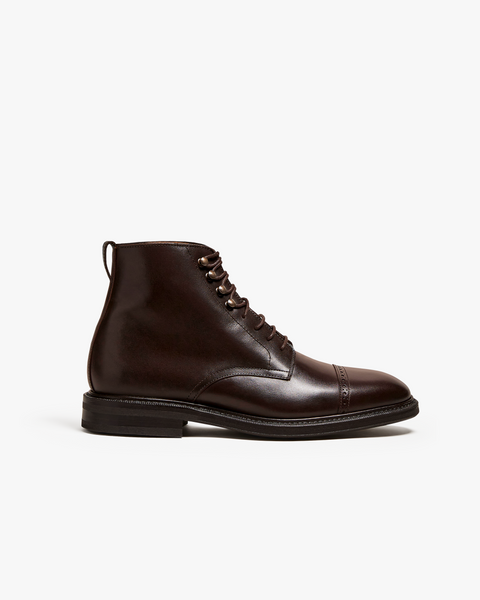
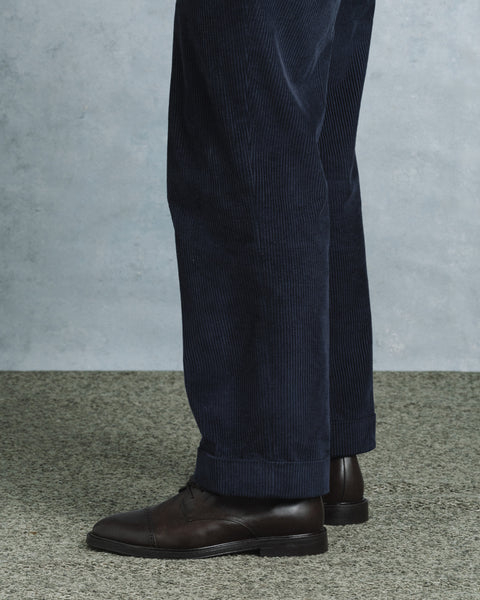
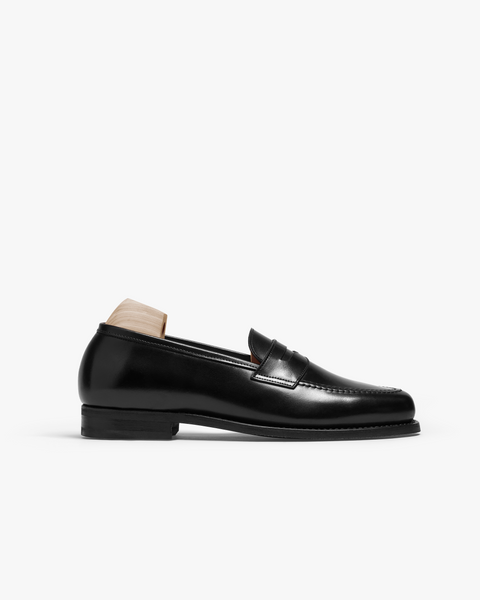
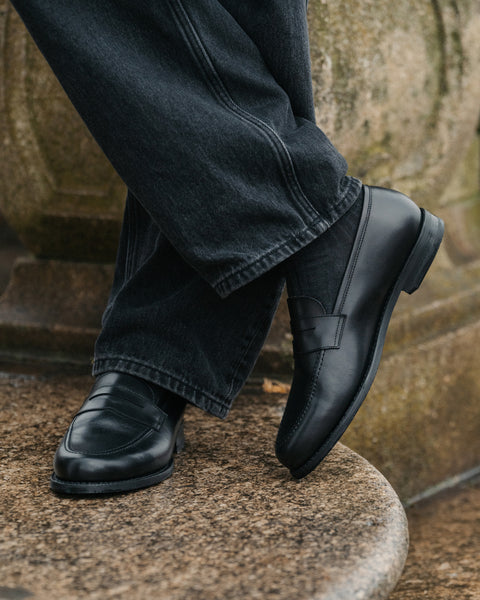
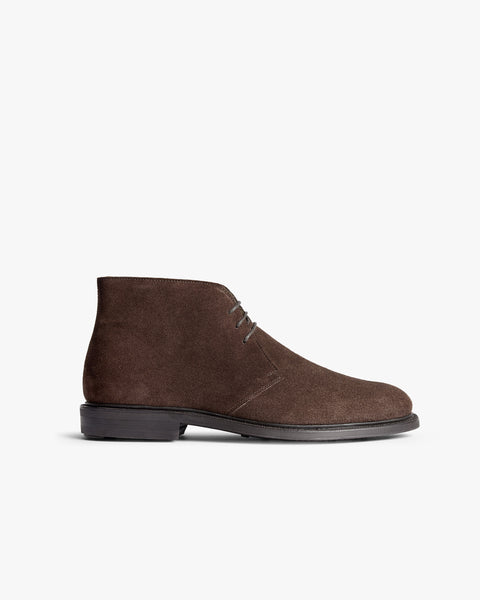
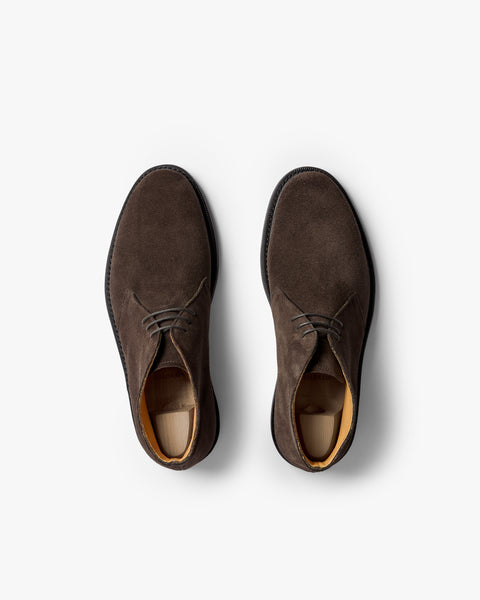
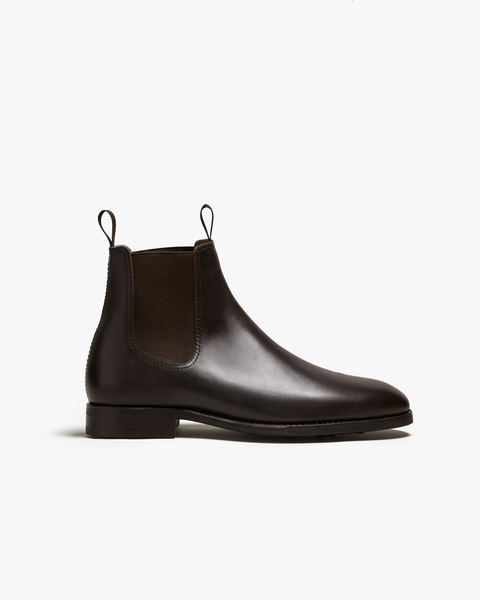
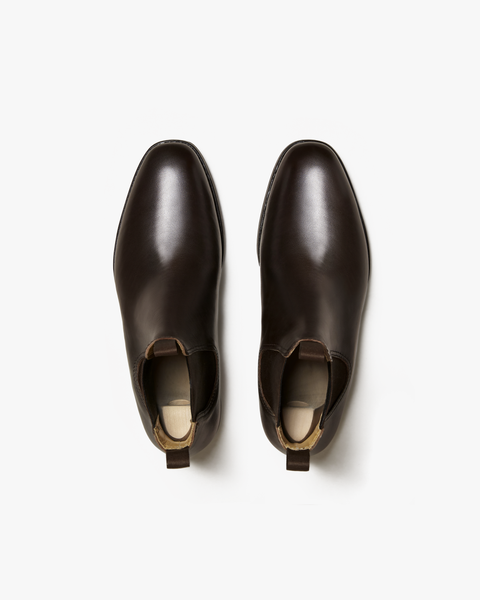


Chelsea boots are worn with the trouser ending at the ankle, so the boot stays visible: keep the leg slim or tapered, let it break clean, and never tuck the denim in. A smooth leather pair in black or dark brown dresses up as far as a suit; suede stays casual and should be protected before the first wear, not after the first soaking. And if a new pair feels loose at the ankle, that's the design rather than a fault — with no laces to tighten, fit is judged at the instep.
A chelsea has no laces and no buckles. An elastic gore set into each side holds it on, and a small tab at the heel gets it over your foot, so the whole mechanism stays out of sight and all you see at the ankle is clean leather. (That's also the quickest way to tell a chelsea from a chukka or a desert boot; if the difference is your real question, we've compared them in chelsea vs chukka boots.)
That design is why the trouser has to end at the ankle instead of covering the boot, why a sleek pair goes further under a suit than you'd expect, why a new pair feels loose around the ankle, and why the suede needs protecting from the first day.
The hem line
The usual mistake is the trouser: cut too wide and hemmed too long, it swallows the boot whole — and once the boot disappears, so does the clean line you bought it for. So keep the jeans slim or tapered, never wide-leg or bootcut, and hemmed to end at the ankle or just above it, with a sliver of boot showing below the hem. Don't tuck the denim into the shaft, and don't cuff it either; a turn-up stacks bulk in exactly the wrong place. Chinos follow the same rule: slim, tapered, cropped at the ankle.
Under a suit
How far a chelsea dresses up depends on how sleek that line stays. The leather should be smooth, not suede. The toe should be a slim almond or a point, not a rounded club. And the sole should be thin. A black or dark brown pair that meets all three sits easily under a suit. The trouser matters as much as the boot here — cut it slim or tapered so it breaks clean at the ankle instead of pooling over the shaft. Too high and you're left with a gap between hem and boot; too low and the cloth bunches over the top. Get the break right and a leather chelsea works at the office, at dinner and at most weddings. Black tie is the exception; even a sleek pair is too casual for a tuxedo.
The loose ankle
Pull on a new chelsea and the ankle will feel looser than you expect. That's not a sizing error; it comes with the design. Your whole foot has to pass through a fixed collar, so the collar can never grip the way a laced boot does, and the fit only loosens from there: the gores soften with wear, and good leather stretches to the shape of your foot. Don't chase a snug ankle — you won't get one. Judge the fit at the instep instead. The midfoot should feel firmly held while the collar sits a touch loose; that hold keeps the boot on long after the gores have relaxed. Expect a short break-in either way.
Protect the suede
Shop suede careA chelsea goes on faster than anything with laces, so it tends to become the pair you wear most, wet days included. That's why suede protection can't wait for the first downpour: it should go on while the boots are new, before they've seen any weather at all. Keep cream and wax polish away from suede altogether — both flatten the nap instead of shielding it. For everyday wear, follow the three steps below. For the harder cases (a boot soaked through, pale suede you're worried about darkening, the different care a smooth-leather pair needs), our guide to cleaning and protecting suede shoes covers it, and the kit is in the suede-care collection.
Brush the nap
Run a suede brush over the whole upper, working in one direction to lift the pile and clear off surface dust. Brushing the same way each time keeps the nap sitting evenly.
Apply a light coat of protector
Hold the can back from the boot and lay down a fine, even mist of suede protector. Go light: two thin passes beat one heavy soak, and a heavy soak can darken pale suede.
Let it dry, then re-brush
Let the boots dry well away from any heat source, then brush the nap once more to lift the pile. Repeat every few weeks, and after any hard wear.
Protect your suede
View all


Built to be resoled
Wear a boot that often and the sole becomes the weak point. A chelsea doesn't need to be Goodyear-welted, but it should be resoleable. A stitched sole can be replaced when it wears through, and the boot gets years more wear; a glued sole can't be, so the boot only lasts as long as its first sole. (Our guide to what a Goodyear welt actually is explains how the construction works and why it matters.) That distinction counts for most on a boot worn through winter, rain and road salt — which is exactly the weather a chelsea is for.
Our Granhult is Goodyear-welted and handcrafted in Portugal. Not every pair we make is built the same way — the Elfvik is Blake-stitched, which resoles just as well. Either way, when the sole goes you replace the sole, not the boot. Slip cedar trees inside them between wears, keep up the suede routine above, and one pair will last you years.
One more question
Can you wear chelsea boots in summer?
Not with shorts — a boot and a bare leg don't work together. In warm weather, wear an unlined suede pair with lightweight chinos or linen trousers instead.


